Your cart

Protecting Sensitive Data on Public Wi-Fi at Business Conferences

Protecting Sensitive Data on Public Wi-Fi at Business Conferences

The coffee is still hot and the lanyard is around your neck. You settle into a seat in the hotel lobby, open your laptop, connect to the convention centre Wi-Fi, and pull up the client presentation without thinking twice. It is a routine most Singapore conference-goers have repeated a hundred times.

But that routine carries genuine risk. Hotel and convention centre networks are shared by hundreds of devices at once. Attendees, visitors, hotel staff, and sometimes people with no legitimate reason to be there all share the same access point. The moment that connection touches a client database, an internal document, or a live product demo in front of a room full of prospects, how secure it actually is starts to matter very much.

These are the steps that protect your corporate data at conferences, without costing you more than a few minutes of preparation.

Connection Security Essentials

Public Wi-Fi at a business conference is one of the highest-risk environments your corporate data will ever travel through.

  • A VPN does not protect you unless you verify it is actively routing your traffic before you connect to anything corporate.
  • Auto-connect features on laptops and phones can silently attach to an unsecured or rogue network before you have had any chance to activate your VPN.
  • A one-minute IP address check confirms whether your encrypted tunnel is live and should happen before every new session at every new venue.

Why Conference Wi-Fi Puts Corporate Data in a Difficult Position

Public Wi-Fi attacks do not require a highly skilled attacker. Someone with a laptop, freely available software, and a seat in the same hotel lobby as you can intercept unencrypted traffic on a shared network. This type of attack, where a third party positions themselves between your device and the internet, is known as a man-in-the-middle attack. It is more common at large professional events than most people assume.

Singapore’s conference scene is dense with high-value targets. Multi-day technology summits at Suntec, regional boardroom sessions at Marina Bay hotels, and hybrid product launches where teams dial in from across Asia Pacific are exactly the kinds of events that draw both corporate participants and opportunistic eavesdroppers. The combination of senior attendees, shared credentials, and live data access creates a concentrated risk environment.

There is also the issue of rogue hotspots. These are fake wireless networks set up to mimic the name of the legitimate hotel or venue connection. A device that joins one routes all its traffic through a third party, with no visible sign that anything has gone wrong. Singapore’s Cyber Security Agency has flagged wireless network risks for businesses as an ongoing concern, and the conference environment is one of the clearest examples of where those risks become concrete.

Choosing a VPN That Performs Under Conference Conditions

Not every VPN holds up well in a high-traffic venue. When a conference draws several thousand attendees, dozens or hundreds of them may be running VPN clients simultaneously on the same network. Some services throttle bandwidth or drop connections under that kind of load. For anyone presenting a live demo, joining a hybrid board session, or uploading a large file mid-conference, a VPN that cannot handle congestion is not much use.

These qualities matter when selecting a VPN for conference travel:

  • A kill switch that cuts all internet traffic the moment the VPN drops, rather than silently falling back to the raw, unprotected network.
  • Split tunnelling so you can route corporate traffic through the encrypted tunnel while keeping video conferencing tools on the local connection where needed.
  • Modern protocol support such as WireGuard or OpenVPN, which tend to handle congested networks more reliably than older options.
  • Servers in or near Singapore to keep latency low during local hybrid sessions.

If your organisation provides a corporate VPN client through the IT department, start there. Consumer products are a reasonable alternative, but avoid free services. Free VPNs frequently monetise user data in ways that defeat the entire purpose of using one.

Confirming Your VPN Is Actually Routing Traffic Before You Log in

Many attendees open their VPN app, see a connected status, and treat that as confirmation enough. It is not always. A failed handshake, a misconfiguration, or a software glitch can leave your traffic on the raw network while the app continues showing a green icon. The only way to know for certain is to check what IP address the outside world sees from your device, before and after activating the VPN.

Run through this process before opening any corporate system at a conference:

  1. Connect to the hotel or venue Wi-Fi as normal, with your VPN not yet running.
  2. Use an online tool to check your current IP address and note the value.
  3. Activate your VPN and wait for the client to confirm the connection is established.
  4. Check your IP address again using the same tool.
  5. If the displayed address has changed to one associated with your VPN provider’s server, the tunnel is live and your traffic is encrypted. If it shows the same address as before, the VPN is not routing your traffic correctly.

This adds about 45 seconds to your setup. Do it before every new connection at every venue, not just on the first morning of a multi-day summit.

When the IP Address Check Fails

Close the VPN client fully and reopen it. If that does not resolve the issue, switch to a different protocol within the app settings. Many hotel and convention centre networks block specific VPN ports, and changing the protocol often gets around this. If nothing works, tether your laptop to your mobile hotspot before touching anything corporate. Do not try to work around a failed VPN.

Disabling Auto-Connect Before You Leave for the Conference

Auto-connect is convenient at home. At a conference, it is a real liability. Your laptop or phone may attach to a network with a familiar-sounding name, perhaps the standard guest network label used by a hotel chain you have stayed at before, before you have had a chance to activate your VPN. That brief, unprotected window is enough for certain passive attacks to capture session tokens, authentication headers, or login credentials.

On Windows and macOS

On Windows, open your list of known Wi-Fi networks, select each one that is not your home or office connection, and uncheck the option to connect automatically. On macOS, go to System Settings, open Wi-Fi, and edit each saved network to disable auto-join. For networks from previous trips that you are unlikely to use again, forgetting the network entirely is the cleaner option.

On iOS and Android

iOS lets you turn off auto-join for individual saved networks directly from the Wi-Fi settings screen. Android handles this differently depending on the manufacturer, but most versions let you long-press a saved network to access its connection options. Some Android versions also include a setting to avoid connecting to open networks without a password. That option is worth enabling before any conference trip.

How Connection Methods Compare at a Busy Conference Venue

Security Trade-offs Across the Most Common Conference Connection Options

Connection Type Traffic Encryption Interception Risk Suitable for Corporate Access
Public Wi-Fi, no VPN HTTPS only (partial) High No
Public Wi-Fi with verified VPN Full encrypted tunnel Low Yes, after IP verification
Mobile hotspot (personal SIM) Cellular encryption Very low Yes, preferred for sensitive tasks
Event-managed corporate network Depends on IT configuration Medium to low Only if confirmed by your IT team

Staying Sharp During Live Demos and Hybrid Boardroom Sessions

Live product demos carry a specific risk that is easy to miss in the pressure of a conference day. The screen you are presenting is visible to the room, but the network traffic behind it is equally exposed if your connection is not properly secured. Corporate authentication tokens, session identifiers, and API calls made during a live demo all travel across the network in real time.

For hybrid sessions where remote participants join by video link, authentication events happen repeatedly as people log in, rejoin after drops, or switch devices. If your VPN loses connection mid-session without triggering the kill switch, those credentials pass through the shared network unprotected until you notice and reconnect.

Test your VPN connection specifically in the room or hall where you will be presenting, not just from the lobby on arrival. Signal strength and network behaviour can differ significantly between a hotel lobby, a meeting room three floors up, and a main conference hall with several thousand people filling it. For any session involving sensitive client data, financial figures, or proprietary product information, consider tethering your laptop to a mobile hotspot for the duration rather than depending on venue Wi-Fi at all.

Brief your co-presenters on these same steps. A compromised connection through a colleague’s laptop on the same shared network can expose your session just as effectively as one through your own device. Security is only as strong as the least-prepared person in the room.

The Habit That Keeps Your Data Where It Belongs

Most data incidents at professional events do not happen because of sophisticated technical attacks. They happen because of habit. The routines that feel safe at the office, connecting fast, trusting a recognisable network name, skipping the VPN because the session starts in two minutes, become vulnerabilities the moment you step into a shared public space.

Disabling auto-connect before you travel takes five minutes, once. Verifying your VPN is live before each session adds under a minute. Keeping your mobile hotspot ready as a fallback costs nothing extra on most corporate data plans. These are small actions with a disproportionate effect on your actual exposure.

Singapore’s conference calendar is packed with events where the stakes of a data breach are concrete and serious. Multi-day summits, hybrid product launches, cross-border boardroom sessions. These are not settings where a rough assumption of safety is good enough. A few minutes of preparation before you leave your hotel room is a small price for the confidence that your corporate data stays exactly where it belongs.
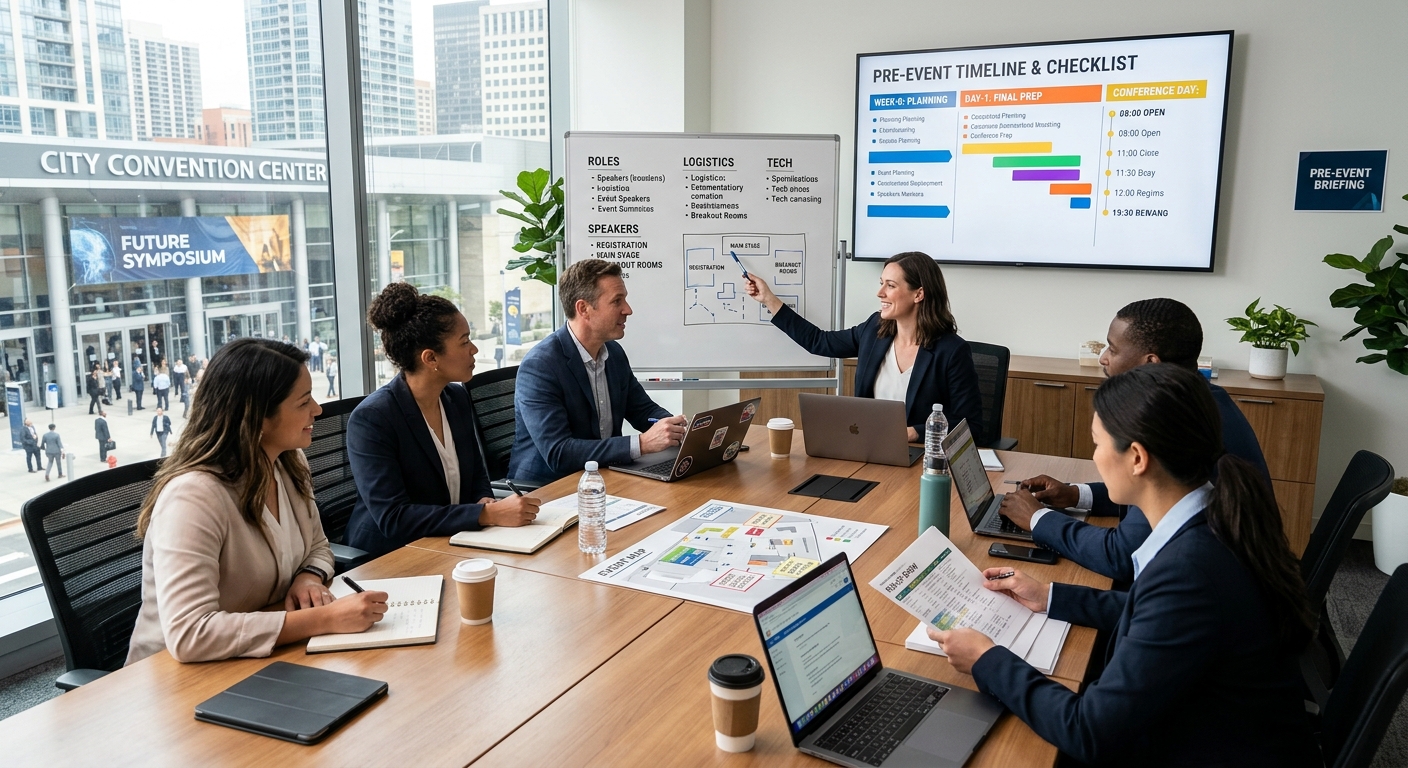
How to Structure Pre-Event Meetings for a Smoother Conference Day

How to Structure Pre-Event Meetings for a Smoother Conference Day

The conference day itself rarely falls apart because of bad luck. It falls apart because of poor planning meetings. A missed follow-up here, an unclear decision there, and suddenly nobody knows who confirmed the AV setup or whether the catering brief was sent. Pre-event meetings are where smooth conferences are made or broken, and most event professionals in Singapore are running far too many of them with far too little structure.

Getting pre-event meetings right is a system, not a checklist.

  • Map your meeting lifecycle from initial stakeholder alignment through to the final-day briefing, with each stage serving a distinct purpose.
  • Every meeting needs a clear agenda, assigned owners, and documented decisions before anyone leaves the room.
  • Distributed teams need a single source of truth for meeting notes, follow-ups, and RSVPs across every planning stage.

Why Pre-Event Meetings Often Derail Before the Conference Day Starts

Most event professionals are not short on meetings. They are short on meetings that actually move things forward. The typical pre-event planning cycle involves at least four to six distinct meeting types, each with a different audience and a different purpose. When these get muddled together, decisions get delayed and accountability disappears.

Singapore’s business events industry is among the most active in Asia-Pacific, with international delegates, multi-stakeholder venues, and complex vendor networks adding real coordination pressure. That pace punishes vague planning meetings. When twenty people sit in a call without a proper agenda, you do not just waste an hour. You push critical decisions forward by a week, and then spend two more chasing them down.

The fix is not fewer meetings. It is better-structured ones with clearer intent at each stage of the planning cycle.

Mapping the Conference Planning Meeting Lifecycle

Think of the lead-up to a conference as a funnel. At the top, you have wide stakeholder input. By the final day, it narrows to a tight operational briefing for the on-ground team. Every meeting in between has a specific job to do, and knowing what that job is before you send the calendar invite changes everything about how productive the session will be.

The lifecycle moves through four broad phases. The first is the initial stakeholder alignment session, held eight to twelve weeks out from the event. This is where the conference vision, budget parameters, and success criteria get established. The second phase involves working group sessions with individual teams covering content, logistics, and communications. These sessions typically happen at the four-to-six-week mark. The third phase is vendor check-in calls, scheduled around the two-to-three-week point, where external partners confirm their deliverables. The fourth phase is the final-day briefing, held the evening before or the morning of the event itself.

Keeping these phases distinct prevents executive stakeholders from sitting through venue logistics debates, and stops the AV team from waiting out an hour of brand strategy discussion that has nothing to do with them.

How Meeting Purpose Shapes Who Needs to Be in the Room

A common mistake is treating every pre-event meeting as an all-hands session. The stakeholder alignment meeting needs senior decision-makers and budget holders. Working group sessions need only the team leads responsible for that particular stream. Vendor calls need the relevant internal coordinator and the supplier. Nobody else.

The final-day briefing is the exception. This one should include everyone who will be on-site. It is a confirmation meeting, not a decision-making one. All decisions should already be locked by this point in the process.

A Side-by-Side Look at Each Planning Meeting Stage

Different stages of the planning cycle demand different levels of detail and different attendee mixes. The overview below makes the distinction clear for mid-to-large conference teams who need to plan their meeting calendar early.

Meeting Stage Primary Purpose Who Should Attend Timing Before the Event
Stakeholder Alignment Set vision, scope, and budget Senior leads, budget holders 8 to 12 weeks out
Working Group Sessions Resolve stream-specific decisions Team leads per stream 4 to 6 weeks out
Vendor Check-Ins Confirm external deliverables Relevant coordinator and supplier 2 to 3 weeks out
Final-Day Briefing Confirm logistics, roles, contingencies All on-site staff Night before or morning of

Setting Agendas That People Will Actually Follow

An agenda is not a list of topics. It is a sequence of decisions that need to be made within a set time. That distinction matters enormously in practice. If your agenda reads “discuss venue setup,” you will leave the meeting having discussed it, with nothing resolved. If it reads “confirm venue layout and assign setup coordinator by end of session,” you leave with a decision and a name attached to it.

For every agenda item, write the desired outcome in one sentence. Assign a time limit. Assign who owns the conversation for that item. Send the agenda at least 24 hours in advance with any relevant pre-reads attached. This is non-negotiable for stakeholder alignment sessions, where senior attendees have limited time and zero patience for cold briefings that require them to absorb large amounts of information on the spot.

Time-box ruthlessly. A 60-minute meeting with five agenda items gives you roughly ten minutes per item after the first few minutes of settling in. If a topic needs 30 minutes, give it its own dedicated session rather than letting it crowd out everything else on the list. The most disciplined conference planners treat their agendas the same way they treat their run-of-show: every minute is accounted for.

Assigning Ownership Without the Confusion

Shared responsibility is the enemy of conference planning. When three people are responsible for something, nobody is. Every action that comes out of a pre-event meeting needs one person’s name attached to it, a clear deliverable, and a hard deadline.

Document this during the meeting, not after. Have one person serve as the designated note-taker whose only job is capturing decisions and actions in real time. At the end of every meeting, read the action items aloud. Confirm names, deliverables, and dates before anyone closes their laptop. Send the summary within two hours. Do not let it sit until the following day, because it will never be as accurate as it was in the room.

For mid-to-large conferences with teams spread across multiple departments, this process generates a significant volume of follow-ups. Tracking these manually across spreadsheets and email threads is exactly how things slip through the cracks in the weeks before an event.

Keeping Distributed Teams Synced Across the Planning Cycle

Many Singapore-based conference teams are not all in one office. Some team members work remotely. Vendors may be based in other countries. International speakers or sponsors could be in entirely different time zones. Keeping everyone aligned across a multi-week planning lifecycle requires more than a weekly video call and a shared folder.

The challenge is not communication frequency. Most distributed teams over-communicate. The challenge is communication clarity. When meeting notes live in one person’s inbox, follow-up tasks are tracked in a separate spreadsheet, and RSVPs are managed through a different form entirely, the planning process fractures. A team member who missed a call has no clear way to catch up without chasing someone down and hoping that person has time to reply.

This is where using a dedicated event meeting planner makes a tangible difference. Centralising meeting notes, follow-up tasks, RSVP tracking, and pre-reads into one shared workspace means every team member has access to the same information, regardless of where they are or what time zone they are in. When a decision is made in a working group session, it is documented and visible to the broader planning team immediately. That kind of transparency cuts down significantly on the back-and-forth messages asking what was decided and who owns which deliverable.

What the Final-Day Briefing Must Cover

The final-day briefing is your last chance to confirm, not to plan. If new decisions are being made at this stage, something has gone wrong earlier in the cycle. The briefing should cover four specific areas: the full run-of-show, emergency contacts and contingency plans, individual role confirmations, and any last-minute changes that came in from vendors or speakers overnight.

Keep this meeting short. Thirty to forty-five minutes is enough for most mid-to-large conferences. Use a printed or shared run-of-show document so everyone is reading from the same source rather than relying on their own notes. Ask each team lead to verbally confirm their readiness before the session closes. End with a reminder of the first escalation point if something goes wrong on the day, and make sure everyone has that contact number saved.

The tone of this meeting sets the emotional temperature of the whole on-site team. Keep it calm, clear, and focused. Confidence spreads quickly in event planning, and so does anxiety. The best final-day briefings feel like a quiet check-in between people who already know exactly what they are doing.

From the Planning Room to a Conference That Actually Runs

The real measure of your pre-event meetings is not whether they were well-run. It is whether the conference day unfolds without frantic phone calls to confirm decisions that were supposedly made three weeks earlier. That is the standard worth aiming for.

When every pre-event meeting has a clear agenda, a designated decision-maker, and a documented outcome, the conference day becomes a matter of execution rather than improvisation. The team on the ground knows what to do because someone sat in a room weeks earlier, made sure the right decision was made, recorded it, and shared it with everyone who needed to know.

Structured pre-event meetings are not about adding more process to an already pressured planning schedule. They are about spending your time in meetings once, getting the right decision, and not spending twice the time untangling the consequences of an inconclusive call that left everyone uncertain of their role.

That discipline is what separates a conference that runs smoothly from one that merely finishes.