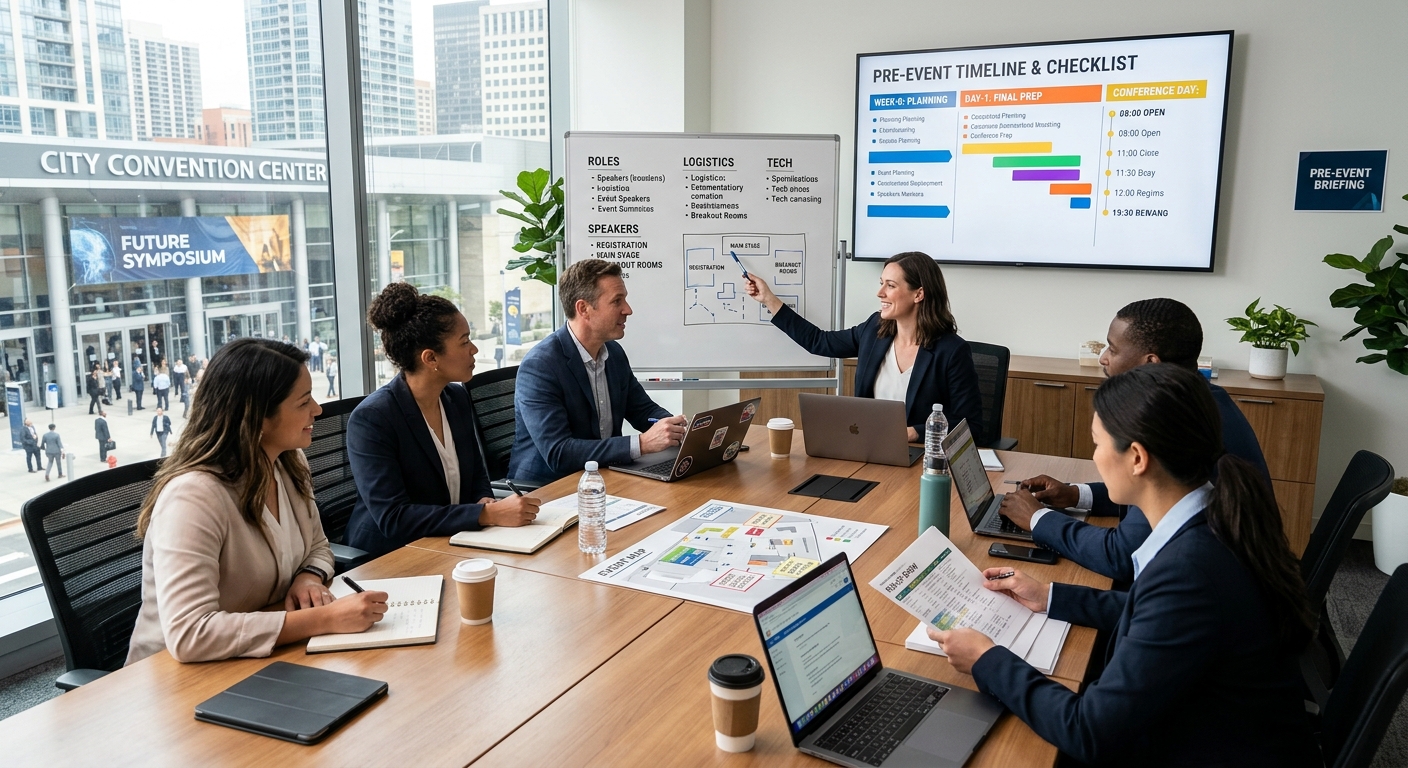
How to Structure Pre-Event Meetings for a Smoother Conference Day
How to Structure Pre-Event Meetings for a Smoother Conference Day
The conference day itself rarely falls apart because of bad luck. It falls apart because of poor planning meetings. A missed follow-up here, an unclear decision there, and suddenly nobody knows who confirmed the AV setup or whether the catering brief was sent. Pre-event meetings are where smooth conferences are made or broken, and most event professionals in Singapore are running far too many of them with far too little structure.
Getting pre-event meetings right is a system, not a checklist.
- Map your meeting lifecycle from initial stakeholder alignment through to the final-day briefing, with each stage serving a distinct purpose.
- Every meeting needs a clear agenda, assigned owners, and documented decisions before anyone leaves the room.
- Distributed teams need a single source of truth for meeting notes, follow-ups, and RSVPs across every planning stage.
Why Pre-Event Meetings Often Derail Before the Conference Day Starts
Most event professionals are not short on meetings. They are short on meetings that actually move things forward. The typical pre-event planning cycle involves at least four to six distinct meeting types, each with a different audience and a different purpose. When these get muddled together, decisions get delayed and accountability disappears.
Singapore’s business events industry is among the most active in Asia-Pacific, with international delegates, multi-stakeholder venues, and complex vendor networks adding real coordination pressure. That pace punishes vague planning meetings. When twenty people sit in a call without a proper agenda, you do not just waste an hour. You push critical decisions forward by a week, and then spend two more chasing them down.
The fix is not fewer meetings. It is better-structured ones with clearer intent at each stage of the planning cycle.
Mapping the Conference Planning Meeting Lifecycle
Think of the lead-up to a conference as a funnel. At the top, you have wide stakeholder input. By the final day, it narrows to a tight operational briefing for the on-ground team. Every meeting in between has a specific job to do, and knowing what that job is before you send the calendar invite changes everything about how productive the session will be.
The lifecycle moves through four broad phases. The first is the initial stakeholder alignment session, held eight to twelve weeks out from the event. This is where the conference vision, budget parameters, and success criteria get established. The second phase involves working group sessions with individual teams covering content, logistics, and communications. These sessions typically happen at the four-to-six-week mark. The third phase is vendor check-in calls, scheduled around the two-to-three-week point, where external partners confirm their deliverables. The fourth phase is the final-day briefing, held the evening before or the morning of the event itself.
Keeping these phases distinct prevents executive stakeholders from sitting through venue logistics debates, and stops the AV team from waiting out an hour of brand strategy discussion that has nothing to do with them.
How Meeting Purpose Shapes Who Needs to Be in the Room
A common mistake is treating every pre-event meeting as an all-hands session. The stakeholder alignment meeting needs senior decision-makers and budget holders. Working group sessions need only the team leads responsible for that particular stream. Vendor calls need the relevant internal coordinator and the supplier. Nobody else.
The final-day briefing is the exception. This one should include everyone who will be on-site. It is a confirmation meeting, not a decision-making one. All decisions should already be locked by this point in the process.
A Side-by-Side Look at Each Planning Meeting Stage
Different stages of the planning cycle demand different levels of detail and different attendee mixes. The overview below makes the distinction clear for mid-to-large conference teams who need to plan their meeting calendar early.
| Meeting Stage | Primary Purpose | Who Should Attend | Timing Before the Event |
|---|---|---|---|
| Stakeholder Alignment | Set vision, scope, and budget | Senior leads, budget holders | 8 to 12 weeks out |
| Working Group Sessions | Resolve stream-specific decisions | Team leads per stream | 4 to 6 weeks out |
| Vendor Check-Ins | Confirm external deliverables | Relevant coordinator and supplier | 2 to 3 weeks out |
| Final-Day Briefing | Confirm logistics, roles, contingencies | All on-site staff | Night before or morning of |
Setting Agendas That People Will Actually Follow
An agenda is not a list of topics. It is a sequence of decisions that need to be made within a set time. That distinction matters enormously in practice. If your agenda reads “discuss venue setup,” you will leave the meeting having discussed it, with nothing resolved. If it reads “confirm venue layout and assign setup coordinator by end of session,” you leave with a decision and a name attached to it.
For every agenda item, write the desired outcome in one sentence. Assign a time limit. Assign who owns the conversation for that item. Send the agenda at least 24 hours in advance with any relevant pre-reads attached. This is non-negotiable for stakeholder alignment sessions, where senior attendees have limited time and zero patience for cold briefings that require them to absorb large amounts of information on the spot.
Time-box ruthlessly. A 60-minute meeting with five agenda items gives you roughly ten minutes per item after the first few minutes of settling in. If a topic needs 30 minutes, give it its own dedicated session rather than letting it crowd out everything else on the list. The most disciplined conference planners treat their agendas the same way they treat their run-of-show: every minute is accounted for.
Assigning Ownership Without the Confusion
Shared responsibility is the enemy of conference planning. When three people are responsible for something, nobody is. Every action that comes out of a pre-event meeting needs one person’s name attached to it, a clear deliverable, and a hard deadline.
Document this during the meeting, not after. Have one person serve as the designated note-taker whose only job is capturing decisions and actions in real time. At the end of every meeting, read the action items aloud. Confirm names, deliverables, and dates before anyone closes their laptop. Send the summary within two hours. Do not let it sit until the following day, because it will never be as accurate as it was in the room.
For mid-to-large conferences with teams spread across multiple departments, this process generates a significant volume of follow-ups. Tracking these manually across spreadsheets and email threads is exactly how things slip through the cracks in the weeks before an event.
Keeping Distributed Teams Synced Across the Planning Cycle
Many Singapore-based conference teams are not all in one office. Some team members work remotely. Vendors may be based in other countries. International speakers or sponsors could be in entirely different time zones. Keeping everyone aligned across a multi-week planning lifecycle requires more than a weekly video call and a shared folder.
The challenge is not communication frequency. Most distributed teams over-communicate. The challenge is communication clarity. When meeting notes live in one person’s inbox, follow-up tasks are tracked in a separate spreadsheet, and RSVPs are managed through a different form entirely, the planning process fractures. A team member who missed a call has no clear way to catch up without chasing someone down and hoping that person has time to reply.
This is where using a dedicated event meeting planner makes a tangible difference. Centralising meeting notes, follow-up tasks, RSVP tracking, and pre-reads into one shared workspace means every team member has access to the same information, regardless of where they are or what time zone they are in. When a decision is made in a working group session, it is documented and visible to the broader planning team immediately. That kind of transparency cuts down significantly on the back-and-forth messages asking what was decided and who owns which deliverable.
What the Final-Day Briefing Must Cover
The final-day briefing is your last chance to confirm, not to plan. If new decisions are being made at this stage, something has gone wrong earlier in the cycle. The briefing should cover four specific areas: the full run-of-show, emergency contacts and contingency plans, individual role confirmations, and any last-minute changes that came in from vendors or speakers overnight.
Keep this meeting short. Thirty to forty-five minutes is enough for most mid-to-large conferences. Use a printed or shared run-of-show document so everyone is reading from the same source rather than relying on their own notes. Ask each team lead to verbally confirm their readiness before the session closes. End with a reminder of the first escalation point if something goes wrong on the day, and make sure everyone has that contact number saved.
The tone of this meeting sets the emotional temperature of the whole on-site team. Keep it calm, clear, and focused. Confidence spreads quickly in event planning, and so does anxiety. The best final-day briefings feel like a quiet check-in between people who already know exactly what they are doing.
From the Planning Room to a Conference That Actually Runs
The real measure of your pre-event meetings is not whether they were well-run. It is whether the conference day unfolds without frantic phone calls to confirm decisions that were supposedly made three weeks earlier. That is the standard worth aiming for.
When every pre-event meeting has a clear agenda, a designated decision-maker, and a documented outcome, the conference day becomes a matter of execution rather than improvisation. The team on the ground knows what to do because someone sat in a room weeks earlier, made sure the right decision was made, recorded it, and shared it with everyone who needed to know.
Structured pre-event meetings are not about adding more process to an already pressured planning schedule. They are about spending your time in meetings once, getting the right decision, and not spending twice the time untangling the consequences of an inconclusive call that left everyone uncertain of their role.
That discipline is what separates a conference that runs smoothly from one that merely finishes.